
Finding Your True North
November 20, 2026 Author: Tess Downing, MBA, CFP®, Complete View Financial
How flexibility and thoughtful planning can help guide your financial future.
Last month, we explored the changing face of retirement and why retirement planning is no longer one-size-fits-all. We examined how traditional retirement is evolving and highlighted alternative paths that offer greater flexibility, letting individuals shape their retirement around their goals, financial situation, and lifestyle preferences.
This month, we can build on that conversation by exploring not just how you retire, but when, and why flexibility around your retirement date can make a meaningful difference to your long-term financial security.
Retirement planning usually starts with a fixed target date, calculating a "safe" withdrawal rate around it; however, in this newsletter we look at a different approach of treating the retirement date itself as a flexible, adjustable variable, since small shifts in timing can dramatically change the market environment ("cohort") a retiree enters.
Here are two sources of retirement outcome variability:
- Cohort risk – the overall market/return environment a retiree happens to retire into
- Pure sequence risk – the order in which returns occur within that same environment
Historical findings show that roughly three-quarters of outcome variability comes from cohort risk, and only about one-quarter from sequence (ordering) risk within a cohort. This matters because common planning tools like dynamic withdrawal strategies, guardrails, and allocation adjustments only address the smaller, within-cohort portion of risk.
Adjusting the retirement date, by contrast, can shift a retiree into an entirely different (better) cohort.
Here are some considerations:
- Allowing a two-year flexibility window around a planned retirement date improved median portfolio outcomes by roughly 40% for otherwise identical retirees with equal starting portfolios.
- When full lifecycles (accumulation + withdrawal) are modeled, that same two-year flexibility produced a median gap of about two-thirds in final portfolio value between the best and worst timing choice within the window.
- Sticking to the originally planned retirement date was optimal only about 15% of the time; in most cases a different timing choice helped, and delaying retirement by one to two years produced the best result in roughly 64% of cases examined.
- This suggests flexible retirement timing can be worth more than simply saving an extra year or two of contributions, since it's really about dodging an unfavorable market cohort.
- Consider working backward from a flexible retirement date range rather than treating the date as a fixed constraint.
- Retirees who look fully "ready to retire" on paper (enough savings, etc.) may still be vulnerable if they retire into a poor market cohort.
- When evaluating a retirement decision, first ask whether you should adjust the retirement date, especially if market conditions look unfavorable at that time.
- When timing flexibility isn't realistic, lowering the initial withdrawal rate offers a margin of safety, while dynamic spending strategies can help manage the remaining (smaller) sequence risk.
Three Strategies to Consider When Planning Your Retirement
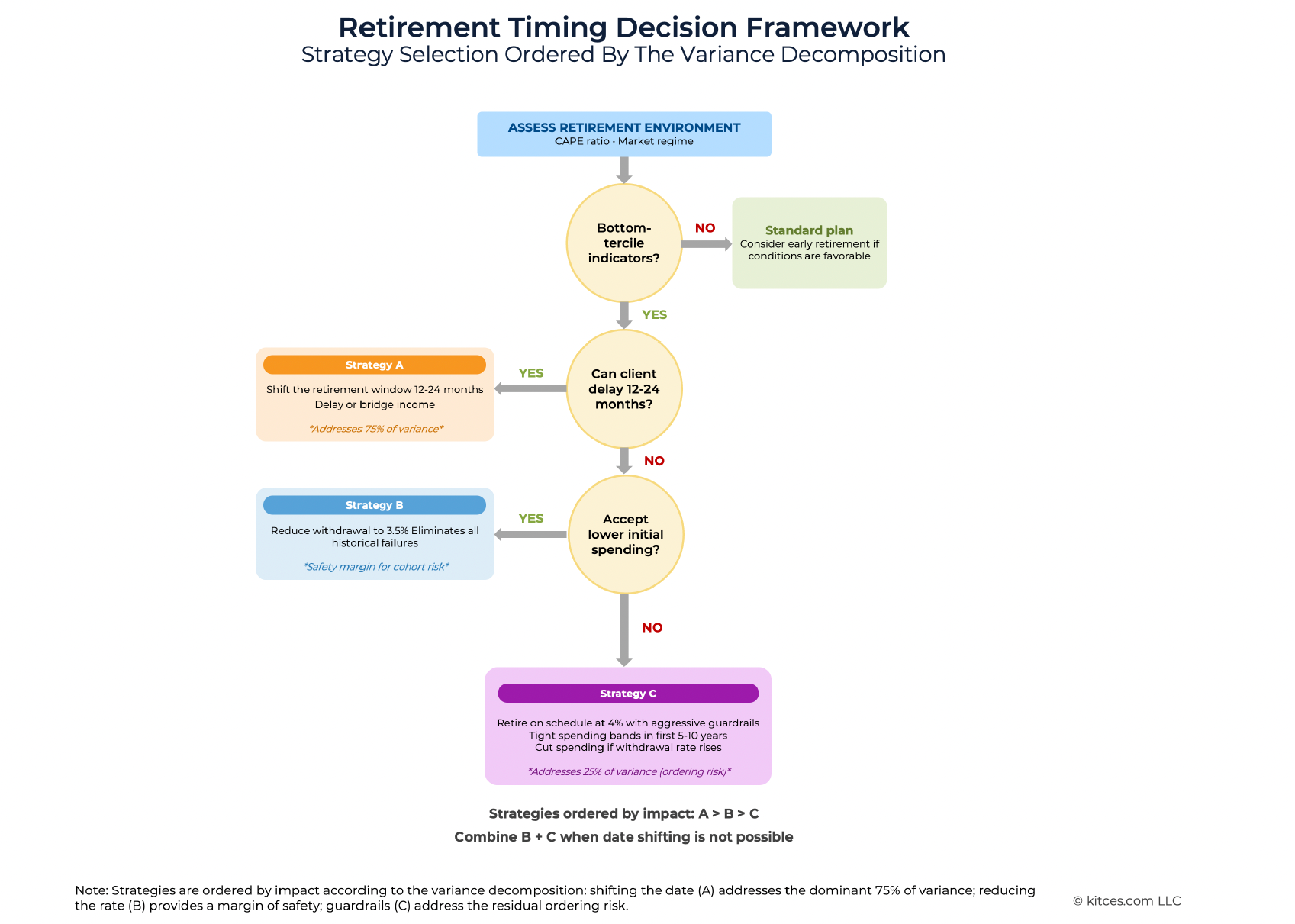
Strategy A: Adjust Your Retirement Date
Consider shifting your retirement date by 12 to 24 months, either earlier or later, depending on your financial readiness and market conditions. Working a little longer, transitioning to part-time employment, or delaying withdrawals could give your savings more time to grow and reduce the impact of retiring during unfavorable market conditions. Even a small adjustment to your retirement date could meaningfully improve your long-term financial outlook.
Strategy B: Reduce Your Initial Withdrawal Rate
If changing your retirement date isn't an option, consider starting retirement with a more conservative withdrawal strategy. For example, reducing your initial withdrawal rate from 4% to 3.5% would mean withdrawing $35,000 rather than $40,000 annually from a $1 million portfolio. This approach can provide additional financial protection while preserving the option to increase spending later if circumstances allow. Starting with smaller withdrawals can help protect your savings during uncertain market conditions
Strategy C: Adopt a Flexible Spending Strategy
If you retire as planned, another approach is to adjust your withdrawals based on market performance. During stronger market periods, you may have more flexibility to spend. During weaker periods, temporarily reducing discretionary expenses could help preserve your savings. This approach can be especially valuable in the early years of retirement, when market declines combined with withdrawals can last longer and affect portfolio sustainability.
Finding Your True North
Retirement planning isn't just about choosing a date; it's about finding the right path to long-term financial security. While your retirement date is an important milestone, the timing of that decision deserves thoughtful consideration as part of your overall financial strategy.
Understanding how market conditions, withdrawal strategies, and potential adjustments to your retirement timeline could impact your savings can help you make more informed decisions. Ultimately, the goal is a plan that keeps you moving in the right direction, toward a confident, financially secure retirement.