
Roth Conversions
July 27, 2026 Author: Tess Downing, MBA, CFP®, Complete View Financial
Should I consider a Roth conversion?
There is one question that I get more than any other question and that is “Should I consider Roth conversions?”
Let’s first begin with what a Roth IRA is and what are the main benefits.
The Roth IRA is an account that allows investments to grow tax-free, distributions are not taxed, and there are no required minimum distributions (RMDs). Combined, these benefits can be part of a successful retirement plan, one that ensures you can invest for the growth your long-term plans need, while still managing your income in a way that creates tax efficiency.
Traditional IRAs and 401(k) plans require minimum distributions (RMDs) to be taken, generally beginning at age 73. Under current law, individuals born in 1960 or later will begin RMDs at age 75. The amounts of these distributions change from year to year based on the value of the plan, and they are taxed as ordinary income.
Now, let’s review the differences between Roth conversions and Roth contributions. They are NOT the same. Roth conversions are also NOT the same as backdoor Roths or mega backdoor Roths.
It’s very easy to get these mixed up, especially since the words “conversion” and “contribution" are so similar.
The biggest difference between Roth conversions and Roth contributions is that there is no limit on the amount you can convert to a Roth, but there are limits for how much you can contribute to a Roth.
For example, you can convert $2 million to a Roth IRA in a single year if you want to, but you absolutely cannot contribute $2 million.
Another difference is that anyone with a Traditional IRA can do a Roth conversion. But Roth IRA contributions are limited to people below a certain income threshold.
In other words, you can make $400,000 dollars per year and pursue Roth conversions. But you can’t make $400,000 per year and make Roth IRA contributions.
So, with that, what exactly is a Roth conversion?
A Roth conversion is the process of transferring money from a Pre-Tax Retirement account into an After-Tax Roth IRA.
Once the conversion is complete, the account can grow tax-free and withdrawals can be tax-free. Generally, if you are age 59½ or older and have satisfied the Roth IRA five-year holding requirement, withdrawals will be tax-free.
Examples of pre-tax traditional retirement accounts include SEP IRA’s, Simple IRAs, and Traditional 401k’s. While inherited IRAs are technically pre-tax retirement accounts, they cannot be converted into Roth IRA’s.
Again, there are no limits on Roth conversion amounts, but that doesn’t mean you should convert hundreds of thousands of dollars or even millions of dollars all at once.
In general, there are three main reasons why an investor would consider Roth IRAs:
Roth IRAs grow tax-free, and money is withdrawn tax-free. In retirement, this keeps you in a lower bracket versus withdrawals from a traditional IRA.
Roth IRAs avoid Required Minimum Distributions (aka RMDs). In addition, Roth 401(k) accounts are no longer subject to lifetime RMDs for the original account owner under current law.
Roth IRAs can be more tax-efficient for your heirs to inherit. While most non-spouse beneficiaries are required to distribute inherited Roth IRA assets within 10 years, qualified withdrawals remain income tax-free.
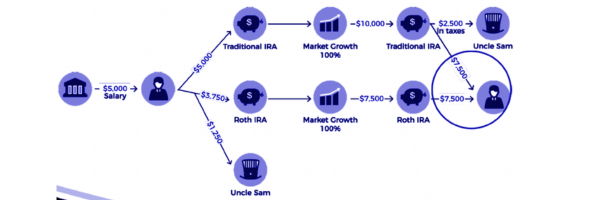
Here is a great visual to explain the tax equivalency principle which states: A certain amount of pre-tax income results in the same amount of after-tax wealth in the end, regardless of which account type it goes to, whenever tax rates remain the same.
Tax Equivalency Principle
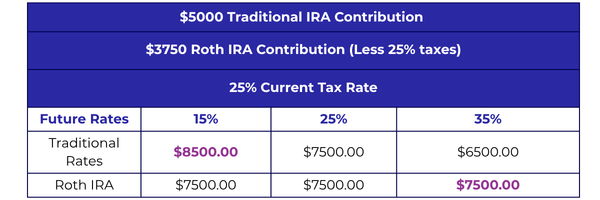
But what if tax rates change? You should pay your taxes whenever your tax rate will be the lowest!
As you can see in the example below, this all depends on your future tax rate. You may know that your future tax rate will be lower just due to no longer earning a paycheck but often tax rates remain the same or can increase in retirement due to pensions, Social Security income, Required Minimum Distributions, and legislative changes.
Future Tax Rates
One popular strategy for Roth conversions is the sweet spot right after retirement, but before you begin to claim Social Security, and before RMDs begin. Your income is often lower during this period, which may create an opportunity to convert assets at lower tax rates.
Many advisors refer to this period as a “tax valley” because taxable income may temporarily be lower than it will be later in retirement.
If you convert after Medicare begins, you’ll need to be careful about how much you convert each year because higher income can trigger Income-Related Monthly Adjustment Amount (IRMAA) surcharges on Medicare Part B and Part D premiums.
Another strategy for Roth conversions is making systematic partial Roth conversions every year. This is similar to dollar cost averaging your way into the market but you are essentially averaging out tax rates over time.
When making Roth conversions, a big benefit comes from paying the tax bill with funds outside of the Traditional IRA. This means tapping into a savings account or taxable brokerage account.
The potential tax savings is all due to being proactive with your tax planning, taking control, and paying taxes when it’s most opportune for YOU. Remember, pay your taxes when your tax rate is lowest.
The benefits of having money in a Roth IRA are powerful. And, while anyone with pre-tax money can do a Roth conversion, it doesn’t mean that EVERYONE should pursue this strategy.
Large Roth conversions can push you into higher tax brackets, increase Medicare premiums, and create unintended tax consequences. This is why Roth conversion strategies should be evaluated carefully within the context of your overall retirement and tax plan.
Reach out if you have any additional questions, Complete View Financial can guide you through these options.