
The Changing Face of Retirement
October 25, 2026
The Changing Face of Retirement
4 Paths Worth Considering: Retirement Is No Longer One-Size-Fits-All
For generations, retirement followed a familiar path: work until your mid-60s, retire, and begin enjoying the life you spent decades preparing for. But what if there were other ways?
You might take an extended break from work earlier in life. Reach a point where work becomes optional. Transition into a less demanding career. Or gradually reduce your hours rather than retiring all at once.
At Complete View Financial, we believe retirement planning is about more than choosing a retirement date. It's about understanding the choices your financial plan can give you, so you can Retire Confidently. Live Better. Leave a Legacy.
The question isn't simply, “When can I retire?” It may be, “What do I want my life to look like, and how can my financial plan help me get there?”
Let’s look at the traditional retirement approach vs. alternatives to consider when planning your future.
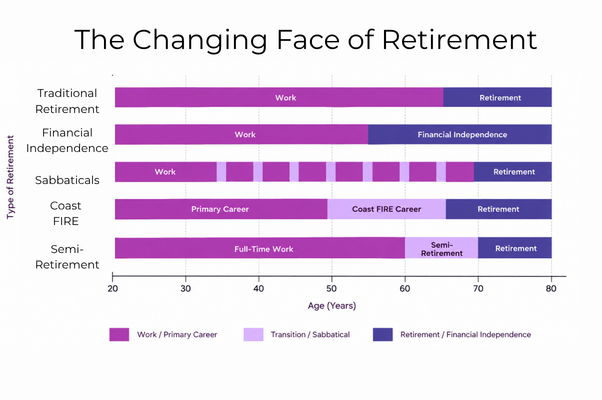
Adapted from: Kitces.com, “Five Types of Retirement and an Advisor’s Role in Helping Clients Plan for Them,” Adam Van Deusen, CFP®, 2026.
What Is Traditional Retirement?
Work Full-Time Until Retirement: Age 65+
Traditional retirement generally means working full-time throughout your career, accumulating savings along the way, and then leaving the workforce completely in your mid-60s to begin retirement. The article's timeline uses approximately age 65 as the transition point.
What it can look like:
- Work and save throughout your 20s, 30s, 40s, 50s, and early 60s.
- Transition from a regular paycheck to retirement savings, Social Security, and other sources of retirement income.
- After leaving work, leisure, travel, family, and other priorities take center stage.
- Retirement tends to happen as one major transition rather than gradually.
Key Takeaway: Traditional retirement is still a viable path—but it isn't the only way to structure your working and retirement years.
Financial Independence
Work Becomes Optional Earlier: Age 45+
Financial independence means accumulating enough assets that you no longer need paid work to support your lifestyle. The article's illustrative timeline shows this happening at approximately age 55, although there is no fixed age—it depends on accumulated assets and anticipated expenses.
Why someone might consider it:
- You may be able to leave full-time work earlier than the traditional retirement age.
- Financial independence doesn't necessarily mean you have to retire. It gives you the option to continue working, reduce your hours, or pursue something different.
- Retiring early can create a much longer retirement, making portfolio sustainability especially important.
- Health insurance can be a significant consideration before Medicare eligibility at age 65.
- Lower-income years after leaving work may create opportunities for strategies such as Roth conversions or capital-gains harvesting.
Key Takeaway: Financial independence isn't necessarily about retiring early—it's about reaching the point where working becomes a choice rather than a financial requirement.
Sabbatical
Taking Some of Your Retirement Time Earlier: Age 30s, 40s, 50s or 60s
Instead of saving all of your free time for retirement, a sabbatical allows you to take extended periods away from work during your career and then return to the workforce.
Why someone might consider it:
- Travel while you're younger and potentially healthier.
- Spend meaningful time with children, parents, or other family members.
- Pursue a personal interest or simply take a break between career chapters.
- Because the break is temporary, it can require fewer assets than early retirement.
- The tradeoff is lost income and retirement contributions during the break—and potentially retiring later.
- Career re-entry matters: your plan should consider whether you can return to a similar role and salary.
- Planning ahead for cash needs can help you avoid selling investments during an unfavorable market.
Key Takeaway: A sabbatical lets you redistribute some retirement time into your working years, when you may be better positioned to enjoy certain experiences.
Coast FIRE
Save Enough Now to Give Yourself More Career Flexibility Later: Ages 50 - 65
Coast FIRE is reached when you've accumulated enough retirement savings that those assets are projected to grow—without additional contributions—to an amount sufficient to support your future retirement needs. You continue working, but only need to earn enough to cover your current living expenses.
Why someone might consider it:
- Transition from a high-paying or demanding career to work that's less stressful or more meaningful.
- Accept a lower salary because you may no longer need to maximize retirement contributions.
- Continue earning enough to cover today's expenses while allowing existing retirement savings time to grow.
- Potentially retain employer-sponsored health insurance and the social benefits of continuing to work.
- Your plan should still be stress-tested for lower investment returns, higher inflation, or periods of unemployment.
- The strategy can also be flexible: the article notes that someone could potentially return to a higher-paying position if circumstances change.
Key Takeaway: Coast FIRE can shift the goal from "How much can I earn and save?" to "How much do I need to earn to support the life I want today?"
Semi-Retirement
Gradually Transition from Work to Retirement: Ages 60-70+
Rather than going from a 40-hour workweek to no work at all, semi-retirement involves significantly reducing your working hours—for example, moving from 40 hours per week to 20.
Why someone might consider it:
- Ease into retirement instead of making an abrupt transition.
- Maintain professional purpose and social connections.
- Continue earning income while gaining significantly more personal time.
- "Test" what retirement feels like before leaving work completely.
- Continuing to earn income can reduce the amount you need to withdraw from investments.
- Working part-time beyond 65 may provide flexibility around when to claim Social Security and can help mitigate sequence-of-return risk.
Key Takeaway: Semi-retirement can bridge your working years and full retirement, giving you more time without immediately giving up all the financial and personal benefits of work.
Bottom Line
Retirement planning doesn't have to be about choosing a single retirement date. It's about creating the financial flexibility to choose how—and when—you want to work, live, and eventually retire.