
The Rules for The Trump Account
June 25, 2026 Author: Tess Downing, MBA, CFP®, Complete View Financial
Overview
One of the more surprising features of the One Big Beautiful Bill Act (OBBBA) of 2025 was the introduction of a new type of retirement account intended to be opened and contributed to on behalf of minor children, called the Trump Account (TA). Designed to give children an early start on long-term retirement savings, Trump Accounts share several similarities with traditional IRAs but include unique contribution and eligibility rules that apply from birth through age 17. While the concept creates a compelling opportunity for early compounding, families should understand both the long-term growth potential and the planning tradeoffs before making it a core savings strategy.
What Is a Trump Account?
- A custodial investment account for children under 18.
- For eligible children born 2025–2028, the government contributes $1,000 to help get the account started.
Can You Open One For a Child Under 18 Who Was Born Before 2025?
- Yes, they just won’t receive the $1,000 government contribution.
How Much Can You Add?
- Up to $5,000 per year (family or others)
- The $1,000 government contribution does not count toward that limit
- Up to $2,500 may potentially come from an employer contribution
How Is It Invested?
- Typically, a low-cost U.S. stock market index fund is designed for long-term growth.
When Can Trump Accounts Be Accessed?
- Funds are generally locked until retirement age without penalties
- Similar to IRAs, penalty-free withdrawals generally begin after age 59½ unless an exception applies
- Earnings are taxable upon withdrawal
Tax Treatment
Trump Accounts contain both after-tax and pre-tax characteristics. Individual contributions are made with after-tax dollars, whereas certain employer, government, and charitable contributions may be treated as pre-tax. Over time, investment growth compounds tax-deferred, but withdrawals in retirement create taxable ordinary income exposure, similar to that of traditional IRAs. This structure can create meaningful long-term tax implications, especially for children who begin saving very early and allow assets to grow for decades.
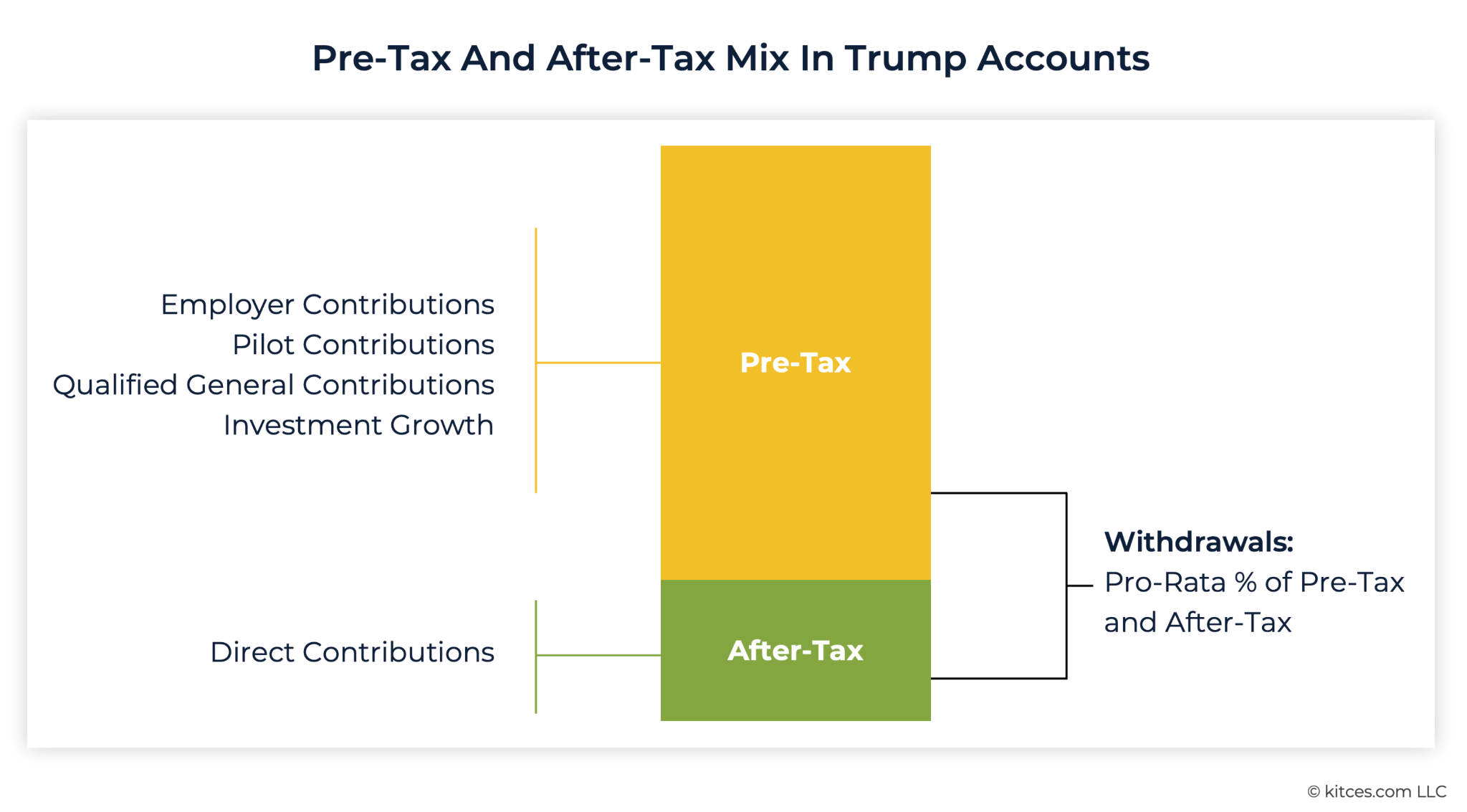
Data Source: https://www.kitces.com/blog/taxable-accounts-custodial-kiddi...
The Catch: How Are Withdrawals Taxed?
- Contributions made with after-tax dollars = tax-free upon withdrawal
- Government, employer, and charitable contributions may be taxable
- Investment earnings = taxable as ordinary income
- This is tax-deferred, not tax-free.
Long-Term Considerations
Trump Accounts may eventually create many of the same challenges associated with large traditional IRAs, including:
- Ordinary income taxation on withdrawals
- Required Minimum Distributions (RMDs)
- Potential beneficiary distribution rules, including the 10-year payout framework
Planning Angle
- Lower tax brackets in early adulthood may create a planning opportunity
- Spreading withdrawals over time may help manage future taxes
- Roth conversion strategies may become important later in life
Impact of TAs On Saving For Children
The biggest advantage of Trump Accounts may simply be encouraging families to start saving early for children. While projections often highlight the impressive growth potential of decades of compounding, similar results may also be achieved with other account structures that offer greater flexibility. For many families, the real value may lie in using Trump Accounts as part of a broader savings strategy rather than relying on them as a standalone solution.
Consider Custodial Accounts as an Alternative
Taxable custodial accounts, such as UTMA and UGMA accounts, may offer several advantages over Trump Accounts despite lacking tax-deferred growth. Because qualified dividends and long-term capital gains may qualify for favorable tax treatment under kiddie tax rules, custodial accounts can potentially build substantially more tax basis over time. This may reduce future taxable income exposure compared with Trump Accounts, in which future withdrawals are taxed at ordinary income rates.
Custodial Account Rules And Kiddie Tax
Traditional taxable custodial accounts may provide:
- More investment flexibility
- Access to favorable long-term capital gains treatment
- Tax-free qualified dividend and capital gain opportunities under kiddie tax thresholds
- Greater liquidity and flexibility before retirement age
Why This Matters
A taxable custodial account may ultimately create:
- Less future taxable ordinary income
- Greater flexibility for pre-retirement use
- More control over long-term tax management strategies
Depending on future tax rates and withdrawal timing, custodial accounts may outperform Trump Accounts from a tax-efficiency perspective.
The Impact Of Roth Conversions
One potential planning opportunity for Trump Accounts is the ability to convert funds to a Roth account later in life. If conversions occur during lower-income years, the taxes may be manageable while allowing future growth to become tax-free. However, the success of this strategy often depends on whether taxes can be paid using outside funds. Otherwise, withdrawals used to pay the conversion taxes may reduce long-term compounding potential and trigger additional penalties.
Roth Conversions For Dependents
For young adults entering lower-income earning years, Roth conversions may become a strategic planning opportunity.
Converting assets during years with lower taxable income may:
- Reduce lifetime tax exposure
- Allow future growth to become tax-free
- Create greater long-term retirement flexibility
Paying The Tax On Roth Conversions
One of the most important considerations with Roth conversions is how the taxes are paid.
Whenever possible:
- Taxes should ideally be paid using outside assets
- Using TA funds to pay conversion taxes may trigger taxes and penalties
- Removing funds early reduces the long-term compounding potential inside the Roth account
Even with Roth conversion opportunities, taxable custodial accounts may still remain competitive due to their flexibility and favorable tax treatment.