
What Investors Can Learn From 2025 Market Trends
February 25, 2026 Author: Tess Downing, MBA, CFP®, Complete View Financial
At first glance, 2025 will likely be remembered as another strong year for U.S. stocks. The S&P 500® Index rose nearly 18% and reached 46 new all-time highs along the way. While that headline number is certainly positive, it doesn’t fully capture what investors actually experienced during the year.
Beneath the surface, 2025 was anything but smooth. Markets delivered strong returns despite frequent bouts of uncertainty—and earning those returns required patience and discipline. Between late February and early April, the S&P 500 fell nearly 19% based on end-of-day closing prices. On April 7, the index briefly entered bear-market territory, declining more than 21% from its late-February high.
That drawdown included a particularly challenging moment: following the April 3 announcement of new tariffs on most U.S. trading partners, the market dropped roughly 6% in a single day. Less than a week later, when many of those tariffs were paused, the market surged nearly 10% in one session. That sharp rebound marked the beginning of a recovery that took just 54 days to fully recoup the losses.
From April 9 through year-end, the S&P 500 gained approximately 39%. Investors who stayed invested through the volatility were ultimately rewarded. The figure below highlights the ups and downs U.S. equity investors navigated throughout the year.
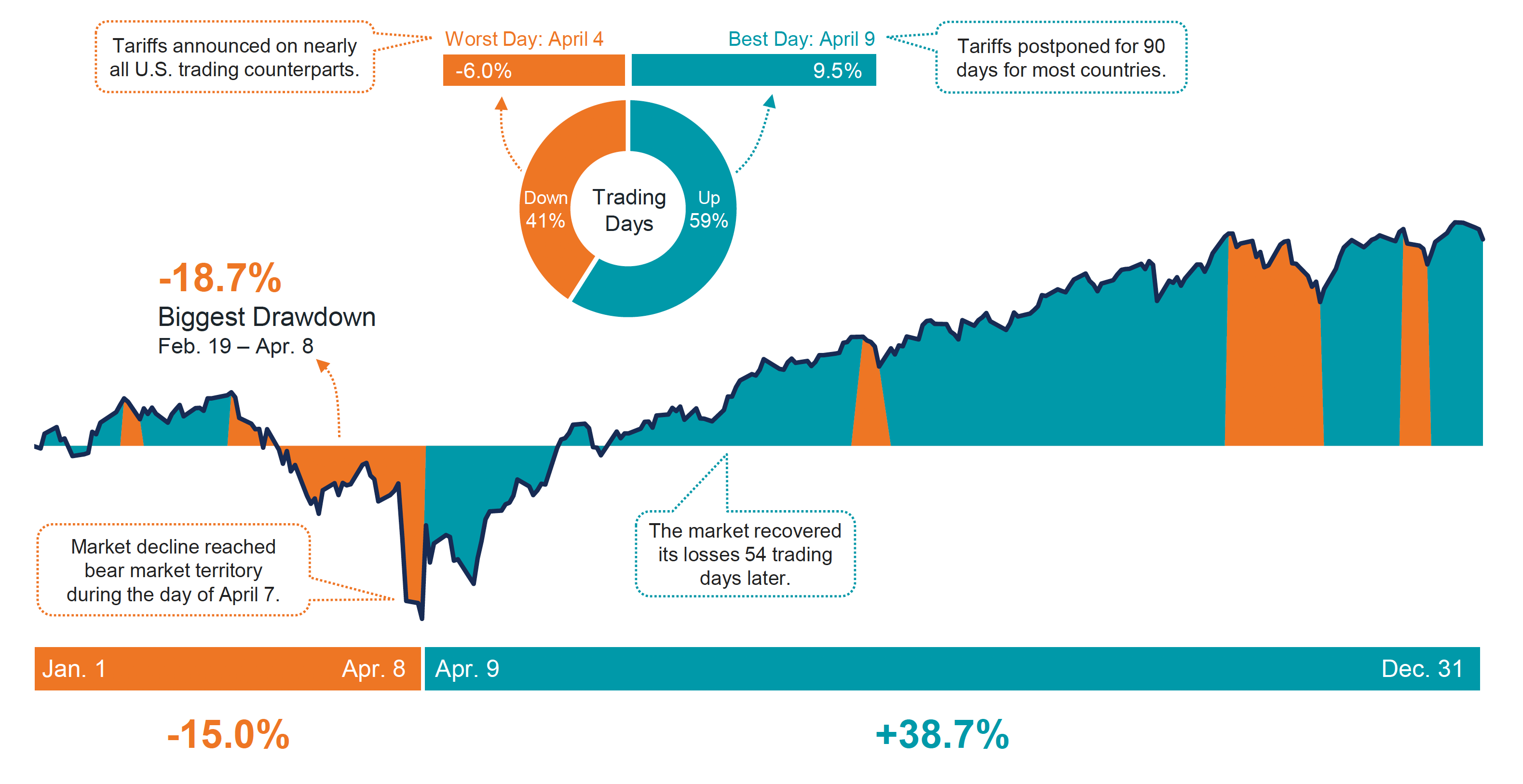
Avantis Field Guide: S&P 500 Index by the Numbers in 2025 (Data from 1/1/2025 - 12/31/2025. Source: Bloomberg, Avantis Investors. Past performance is no guarantee of future results).
A STANDOUT YEAR FOR NON-U.S. STOCKS
No review of 2025 would be complete without acknowledging the strength of non-U.S. markets. For the first time since 2022, non-U.S. stocks outperformed their U.S. counterparts by a wide margin. The MSCI ACWI ex USA Index—which includes both developed and emerging markets—outpaced the S&P 500 by approximately 14.5% in 2025, as shown in the figure below.
This marked the largest annual outperformance by non-U.S. stocks relative to U.S. stocks in the past 15 years. The next closest instance was just over 5% in 2017. Importantly, this relative strength was broad-based. Outperformance was not limited to a single region or segment; many non-U.S. markets delivered returns well above those of the S&P 500.
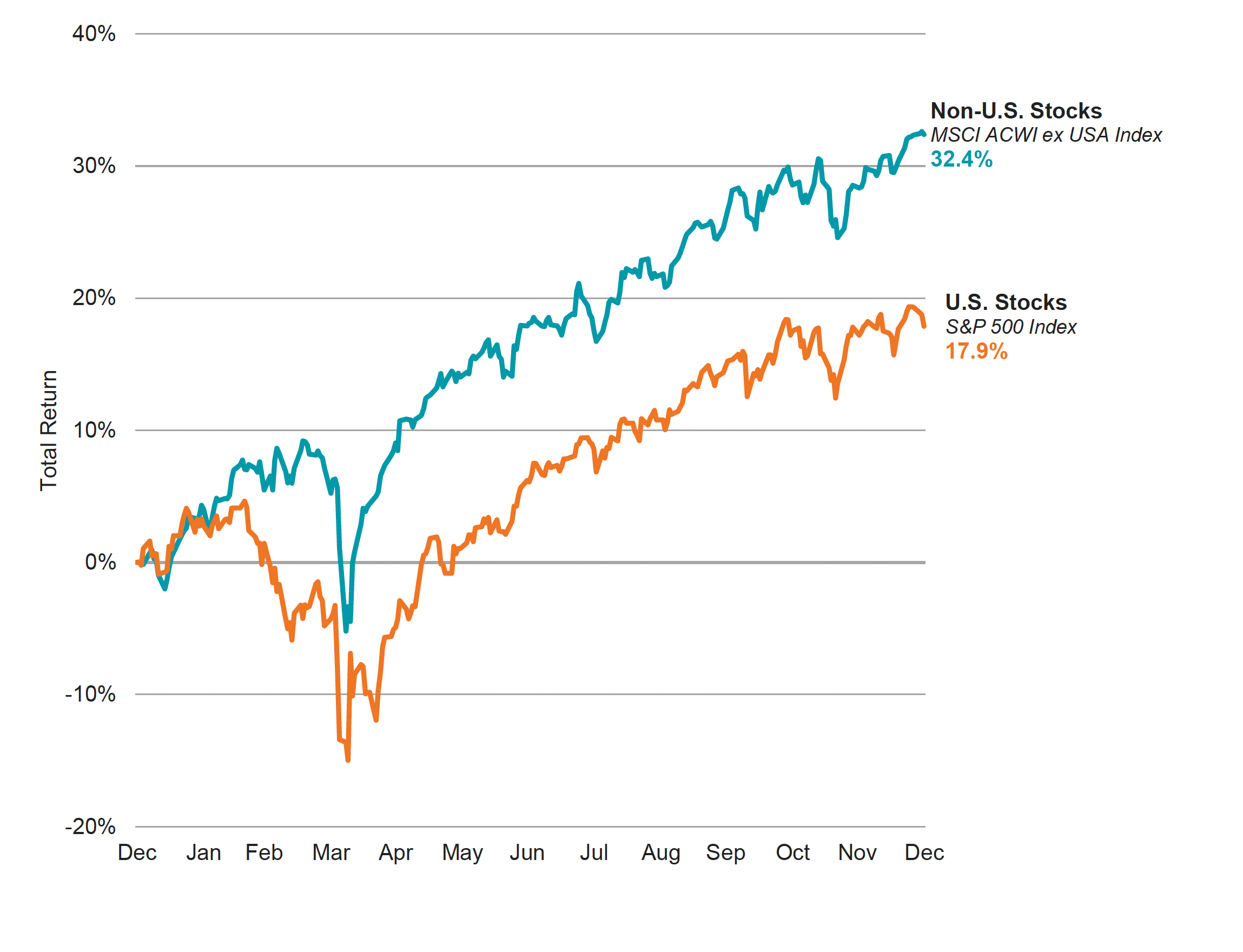
Avantis Field Guide: Non-U.S. Stocks Stole the Show in 2025 (Data from 1/1/2025 - 12/31/2025. Source: Bloomberg, Avantis Investors. Past performance is no guarantee of future results).
BONDS DELIVER SOLID GAINS
Fixed income also played an important role in 2025 portfolios. U.S. Treasuries returned 6.3% for the year, with the yield on the benchmark 10-year Treasury declining to 4.18%. The broader Bloomberg U.S. Aggregate Bond Index gained 7.3%, its best annual return since 2020. Globally, the Bloomberg Global Aggregate Bond Index (hedged to U.S. dollars) rose 4.9%.
TAKEAWAYS FOR THE YEAR AHEAD
By many measures, 2025 was a good year for investors. It’s natural to feel encouraged by strong results while also recognizing that the turn of the calendar doesn’t eliminate uncertainty. As we move into 2026, investors will undoubtedly hear continued discussion about inflation, interest rates, the labor market, and the performance of companies tied to artificial intelligence—along with developments no one is anticipating today.
The experience of 2025, like so many years before it, serves as an important reminder: there will always be reasons to worry about markets, and those worries don’t necessarily prevent positive long-term outcomes. The key is resisting the urge to react to short-term noise and remaining focused on long-term goals. Investing is a journey measured in years and decades, not days or months. Keeping that perspective is a valuable way to begin the new year.
One practical way to cope with market volatility is simply to pay less attention to it. For example, if an investor had checked their portfolio on April 1 and then looked again a month later, they might have concluded that markets were relatively calm. Yet April 2025 turned out to be one of the most volatile months in recent history, as markets rapidly processed changing information about tariffs and their potential economic impact.
This same principle applies over longer periods. With reliable U.S. stock market data now spanning a full century, the long-term evidence is clear. Short-term views highlight dramatic ups and downs, but long-term views reveal a much steadier pattern of wealth creation. Focusing on that long-term trajectory remains one of the most effective strategies investors have.
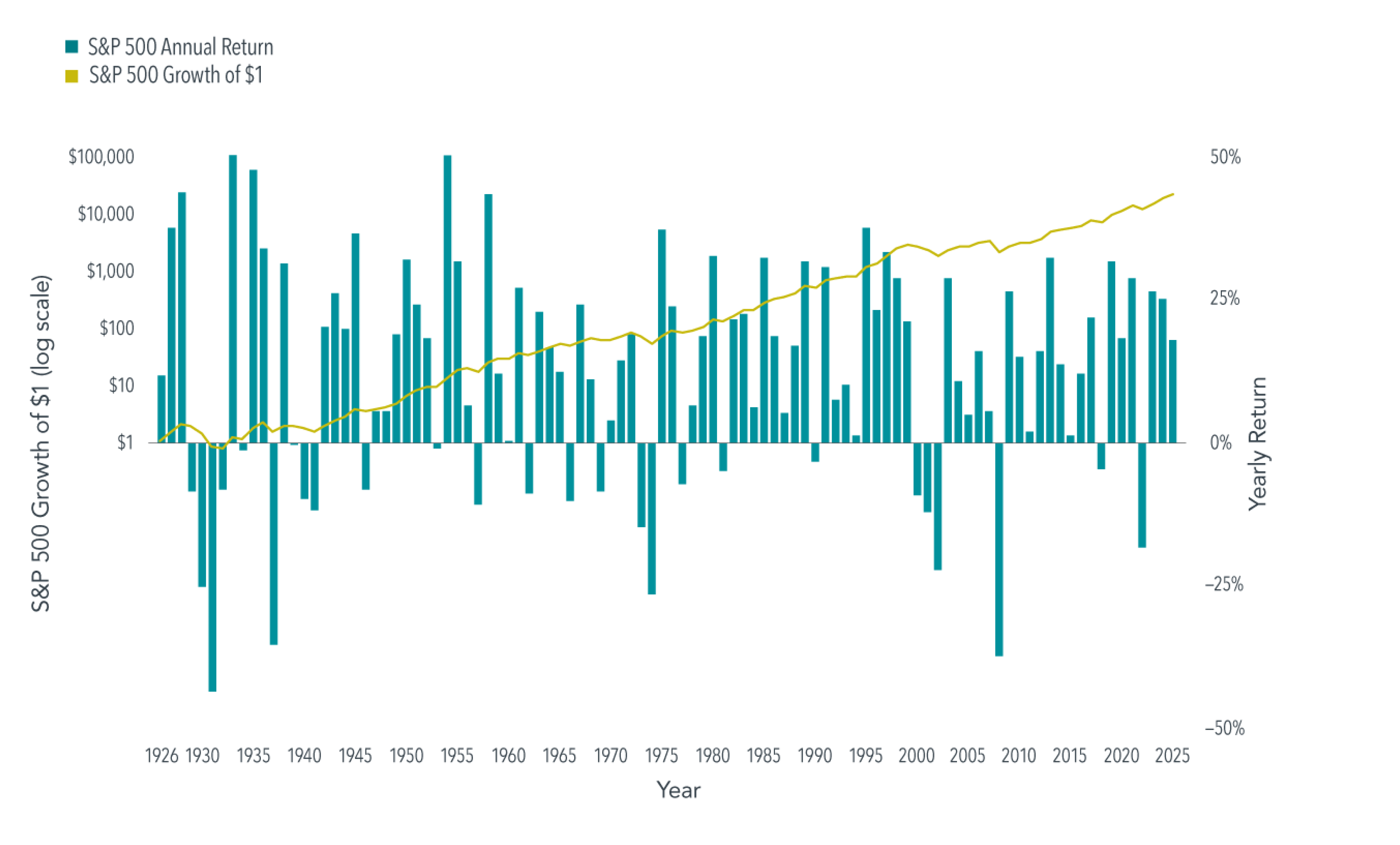
Dimensional Fund Advisors: Two Views of Markets S&P 500, Growth of Wealth vs. Annual Returns, January 1, 1926–December 31, 2025